
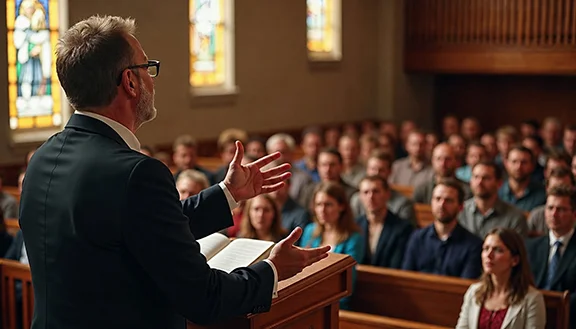
If you study church behavior long enough, you begin to suspect it operates under its own set of natural laws—one of which is that the seat nearest the pastor is perpetually available, like it’s under some kind of protective agreement.
You can walk into a nearly full sanctuary—people scattered like a successful potluck buffet—and yet somehow the front row, center section, “zone of maximum visibility,” remains wide open. It is not just open. It is invitingly open. Like it is trying to communicate, “You could sit here… but you probably won’t.”
And you won’t.
No one does.
This isn’t really about a lack of faith. It’s more like a refined spiritual instinct for humility combined with an equally strong commitment to avoiding sudden public assignments. Because everyone understands what happens in that seat. Sit there once, and you immediately become part of the sermon illustration. The pastor says, “We all struggle with this,” and you spend the rest of the message wondering if he’s making eye contact with you specifically. And then there’s the volunteer effect. You settle in quietly, open your bulletin, and before the second verse of the first song, you hear it: “Could someone in the front row help us…” and just like that, you’re holding a microphone and questioning your life choices.
There is also the issue of proximity. Sitting that close means you are no longer attending a sermon. You are participating in a conversational exchange you never agreed to. The pastor will ask rhetorical questions, and somehow your eyes will answer them.
“Are we really trusting God in every area of our lives?”
And you will nod, because what else can you do? Lie?
Meanwhile, everyone else is safely behind you, spiritually anonymous, sipping coffee and thinking about lunch.
This phenomenon may even have biblical roots. Consider Peter. Every time he got close to Jesus, something happened. A miracle, a rebuke, or an unexpected assignment involving feeding people or walking on water. The pattern is clear: closeness to the front increases both spiritual opportunity and immediate responsibility.
And most of us are just not emotionally prepared for that level of commitment before 10:30 a.m.
Of course, the seat closest to the pastor is not actually dangerous. It just feels consequential. It is the seat where you believe your facial expressions are being interpreted theologically. Smile too much, and you’re insincere. Don’t smile enough, and you’re under conviction.
So it remains empty. Week after week. A silent testimony to the human desire for spiritual growth… at a comfortable distance.
But maybe, just maybe, that seat is not a trap. Maybe it is an invitation. Not to be put on the spot, but to be present. Not to be drafted into service, but to lean in a little closer to what God might be saying.
Still, I suspect next Sunday it will remain open.
And most of us will continue our faithful tradition of sitting somewhere around row eight, where we can worship fully, listen attentively, and remain safely out of range of any spontaneous clipboard distribution.
And honestly… that might be enough grace for one Sunday.